

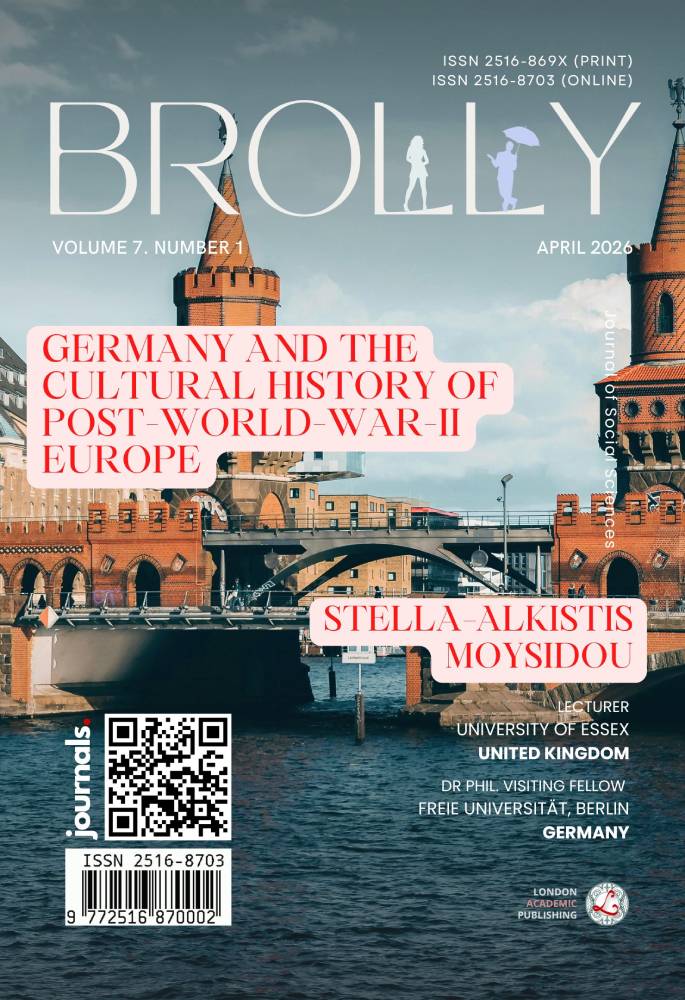
Germany and the Cultural History of Post-World-War-II Europe
by
Abstract
Polychronis Enepekides (1917-2014), an Austrian historian of Greek origin, contends that Second World War worldview and its aesthetics in regard to international understanding and forgiving reconciliations in the aftermath faced a tremendous recession. Female suffrage, a series of profound changes and reforms in the constitutions and legal systems, and a spirit of civic universalism declared a New World order imbued with American principles in post-war Western Europe. Nevertheless, society retained its role of reasserting pre-existing class divisions. A conservative and even conformist attitude in daily activities during the 1950s reflected gender within societal norms. The family was prioritised over other aspirations of liberation and sexual freedom, even though the latter was performed in or away from marital status relationships. The world and civic order imposed by national, social institutions and communities, such as education and the churches or other religious communities, defined new social and interpersonal behavioural norms in the long reconstruction process and resorted to a new normality.
Western Europe was defined as a class society even after 1945. The middle class was prevalent amidst the Cold War, and economy, political life, and the resources of the state were all aligned in ways that served the interests of the middle class, which itself was expanding and changing as a consequence of processes of economic and social modernisation (Conway 2020, 202).
Enepekides highlights the aesthetics in terms of public address: modernism, gender, class and mass culture, post-modern diplomacy, state order and post-war narrative in Western democracy. In this common ground, one can observe his constant concern with the interface that belies the international links shared between modern and post-modern world (both Asian and European) in terms of geopolitical alliances and transnational cultural interconnections.
Published in
Licensing Information

This is an Open Access article, distributed under the terms of the Creative Commons Attribution Non–Commercial No Derivatives License which permits noncommercial re-use, distribution, and reproduction in any medium, provided the original work is unaltered and is properly cited. The written permission of the Publisher must be obtained for commercial re-use or in order to create a derivative work.

